
Why Theater Matters (To Our Family)
Our daughter discovered theater, and her love of it, through the oddest of channels: The Riverdale tv show. The show is loosely based on the old Archie comic, reimagined as a horny, absurdist thriller, teen drama fever-dream. She found it on some steaming service and became hooked. She probably shouldn’t have been watching it at her age, but the things I saw when I was her age (The Evil Dead, Faces of Death, Porky’s) were infinitely worse, and I was hesitant to police what she found comforting and entertaining as the COVID lockdowns were wrecking havoc on her schooling, her social development, and her mental health.
This show provided solace. From what she’s told me, it was like visiting with friends who had adventures, and would sometimes engage in elaborate musical theater set pieces ranging from, Carrie: The Musical (which our daughter would eventually go on to act in), Hedwig and the Angry Inch, Next to Normal, and her favorite, Heathers: The Musical (incidentally, Heathers is one of my favorite films). It was the big theater kid energy that sparked something in her. She found a kinship, a connection; but most of all, I think, she found a kind of permission.
For most of her life, our daughter was quiet. Not around our family—she was a lunatic—but around other people. Slow to open up, slow to make friends—almost painfully shy. We thought we’d possibly had to have her attend therapy to see if she could get some support in this area. So it took us by surprise when she not only started belting show tunes around our house—I started calling it quarantine chorus (not to her face)—but showed an interest in theater.
My wife’s doctor told her about this place in Berkeley, California that specialized in youth musical theater. We enrolled her in an online class, and then another. She took to it like nothing else. She was a highly athletic child, excelled, but had zero passion for sports. Athletics came easy to her, musical theater didn’t, but she worked her behind off, only deterred by online social dynamics, not by what was being asked of her. She put so much time and energy into her training, it was miraculous to watch. She found a way to repurpose that athelticism, coming to a firm understanding that theater was an athletic endeavor, and that she had to train her body and mind as she had to for soccer, volleyball, and karate. Training in musical theater got her to a certain level, but she kind of plateaued. COVID lockdowns stymied what she was able to do. There are few things harder to watch than a highly physical kid being forced to engage with a screen. It limited her range, she wasn’t able to feed off others, and her work was beholden to whether or not the wifi was stable.
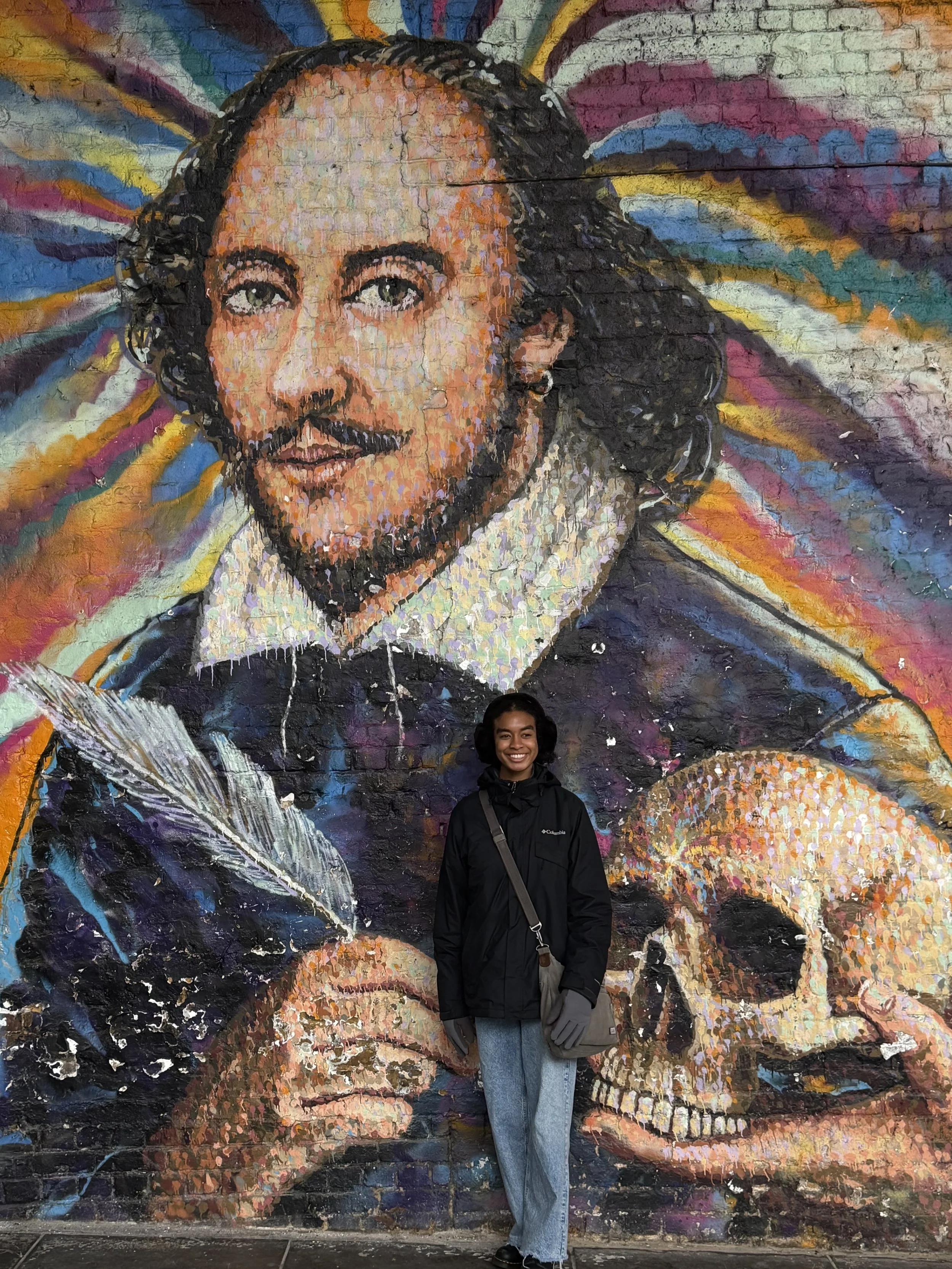
My daughter standing in front of Shakespeare’s giant face near Borough Market in London.
And then Shakespeare entered her life—entered our lives.
Another contact of my wife’s suggested that we send our daughter to online classes at this place that specialized in teaching Shakespeare and Shakespearian acting to young people. They were (are) an absolutely wonderful organization. She took a class, and the culminating project was an online, truncated version of Hamlet. She got the lead—in grand Shakespearean tradition, she has done a couple of gender-swapped Shakespeare characters. She had not only found a social and aesthetic home, she found her purpose.
To see Shakespeare so masterfully choreographed via ZOOM, to see our daughter command the digital stage in such a compelling way, it was awe-inspiring. If musical theater invited her to lean into her more expressive and emotive sides, but ultimately left her wanting more, Shakespeare was was a rocket that took and magnified her desire for connection, to transform people through story, to build supportive friendships and propelled all this into and past the stratosphere. Hell, it is still propelling her today—propelling her into studying for a BFA in acting. Theater allowed her to become herself in a time of uncertainty. And I will always be grateful.
With our current government toying with the idea of not allowing federal student loans to be used for art degrees—because those majors don’t make enough money to pay back the loans—never has theater (and other arts) been more important to support.
I doubt there is a single person in the world who hasn’t used art to navigate tragedy. Art saved us during the pandemic. Art has helped us through hurt and sadness. Art has been there for us at our best and our worst. And to be more specific, in my case, art, namely theater, has helped my daughter become the most amazing version of herself—and she still has so much more growing to do. I cannot wait to witness it.
Theater allowed her to try new things, try on new personalities, live other stories—and when she started directing, craft the look and feel of stories for others to inhabit. Theater give her an expansive database of multiple forms of empathy. Her compassion and generosity are works of art, in and of themselves. Theater let her practice humanity, practice being different versions of herself, practice shining a light on her interpretation of the human condition. In its most effective version, theater has allowed my daughter to engage her dream machinery and rehearse a better world.
She is not the only one. Theater has liberated generations of people. Being the parent of a kid with enormous theater kid energy can be exhausting. I’ve done more driving around for theater stuff than I ever did when she was involved in sports. I’ve been in the middle of so many impromptu sing-alongs with her and her friends—spontaneous Lady M monologues, the recipient of stage combat strikes—I wouldn’t change a thing. If a person, on a stage, with nothing more than their voice and body can make a roomful of strangers contemplate the larger questions of ourselves, who we are in the world, and how to give each other grace, I will support and defend it. Always. You should, too.
